
Notes on contemporary art scene and dance in Bangkok, Thailand Spring 2026
MA Choreography student July Weber writes about the contemporary art scene in Bangkok and interviews Jitti Chompee, director of 18 Monkeys Dance Theatre and Unfolding Kafka Festival.
Introduction
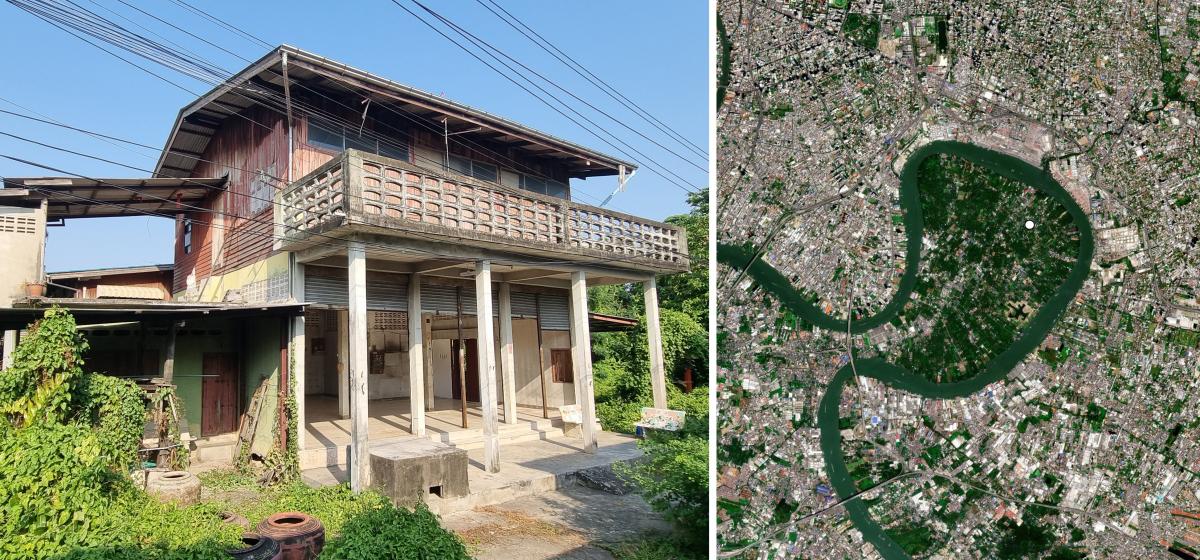
Over the past years, Bangkok has become a city I keep returning to – each visit was shaped by different people, projects, and questions. What began through collaborations with institutions and artists gradually turned into a more personal exploration of the city’s cultural landscape and its striking contrasts between intensity and stillness, urban density and hidden green spaces. In this text, I reflect on encounters with artists, independent initiatives, and art institutions that influenced my understanding of Bangkok’s contemporary art scene, while also questioning my own desire to create a longer-term project on an island in the middle of the city. Rather than formulating a definitive portrait, these notes, observations, and an interview with choreographer Jitti Chompee offer my personal intimate and fragmented perspective on Bangkok’s cultural ecosystems. (It needs 30.000 euro to rent and renovate this beautiful house for 5 years with a lot of potential, send cash:)
A fragment of a city – Bangkok2569
In the past years I came to Bangkok already five times, and every time it was very different in terms of projects, people, and the amount of time I spent. In 2018 I was invited by the Goethe-Institute to join a meeting of ca. 30 artists from Germany and different Southeast Asian countries to build international connections. From there, a collaboration with the Bangkok Art and Culture Centre and the performance group B-floor was initiated that took place in 2019. After a residency in Hong Kong, I visited Bangkok shortly in 2024, and then in 2025 another project supported by the Goethe-Institute could be realized that manifested in a performance and a movie under the title “The Gym of Hope.”
This year I didn’t have a concrete project in Bangkok, but one in Singapore and at the Kochi-Muziris Biennale in India. After that, I travelled again to Bangkok to investigate more into the art scene and to figure out if and how I could possibly start an art and community project in an abandoned house in a very particular environment in the district of Bang Krachao.
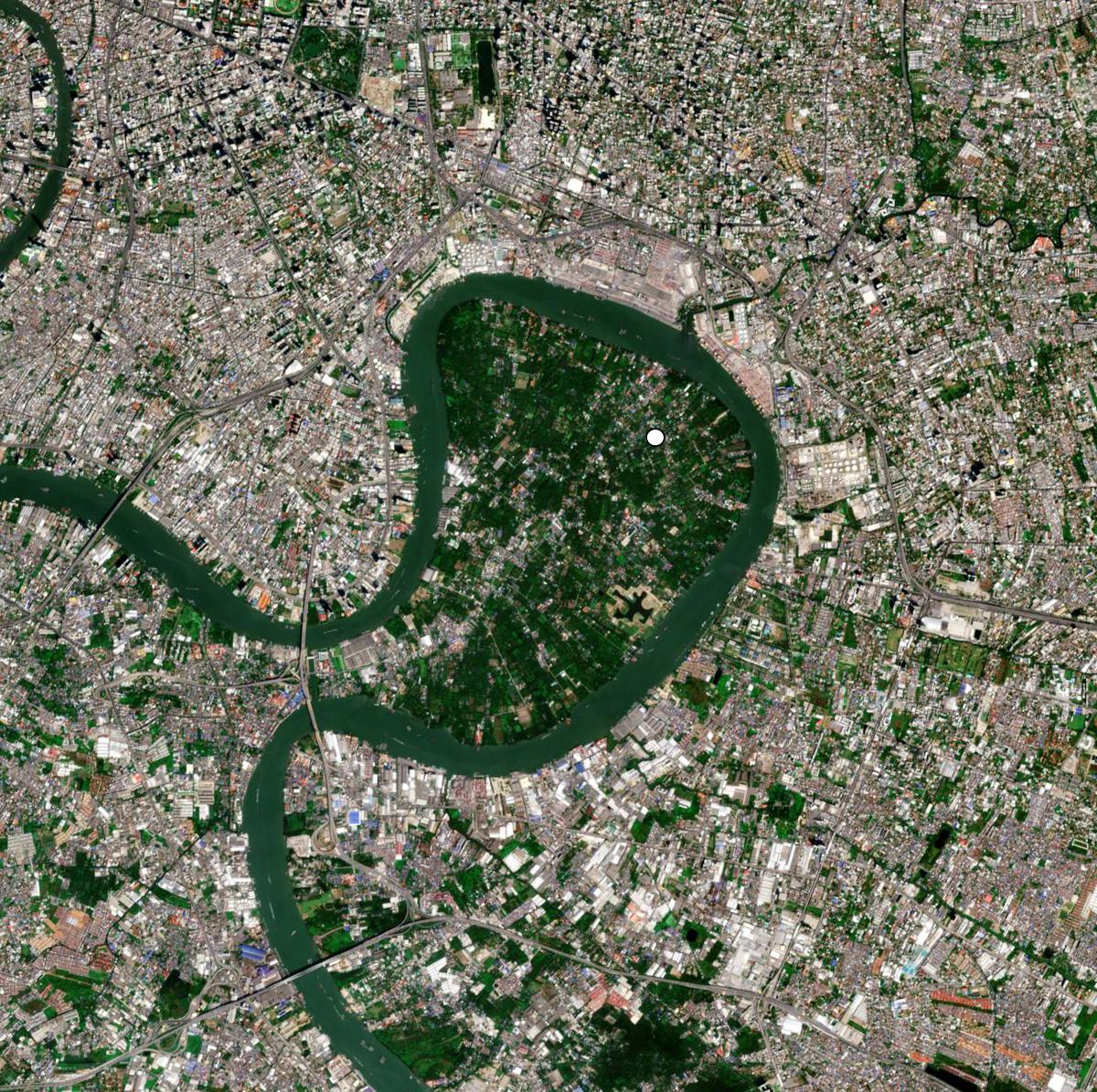
Bang Krachao is an artificial island formed by a bend in the Chao Phraya River and a canal at its western end. The island, covering 16 square kilometres, has been traditionally agricultural with only a relatively small population. It is often referred to as the “green lung of Bangkok” and lies quite centrally inside the ca. 11.5 million-inhabitant metropolis.
What is fascinating to me is that you can cross the river with a small boat in several minutes and shift between these intense extremes: from a green and calm village-like environment to a pulsing, noisy, and densely populated city. In addition, it was surprising to me that this island is nearly forgotten and not known by most inhabitants of Bangkok.
The abandoned house needs a lot of renovation but holds a lot of potential in my eyes. The first floor is basically one big room with a high ceiling and a front wall that can be opened completely by metal gates, which instantly transforms the space into a kind of amphitheatre that could be used as a rehearsal and presentation space. On the second floor are several smaller rooms, which could host artists. There is also a piece of land attached to the house, which would allow some gardening and further constructions. After spending these last two months in Thailand and even starting to clean out the house and live there for some time, I still haven’t clearly decided if I want to take that big step and commit to a long-term project in a completely different environment and culture. But this is another story, as this text is mainly about giving a little insight into what I discovered during this time in the Bangkok art scene. Therefore, I picked two very different institutions and a cultural worker I want to introduce here briefly.
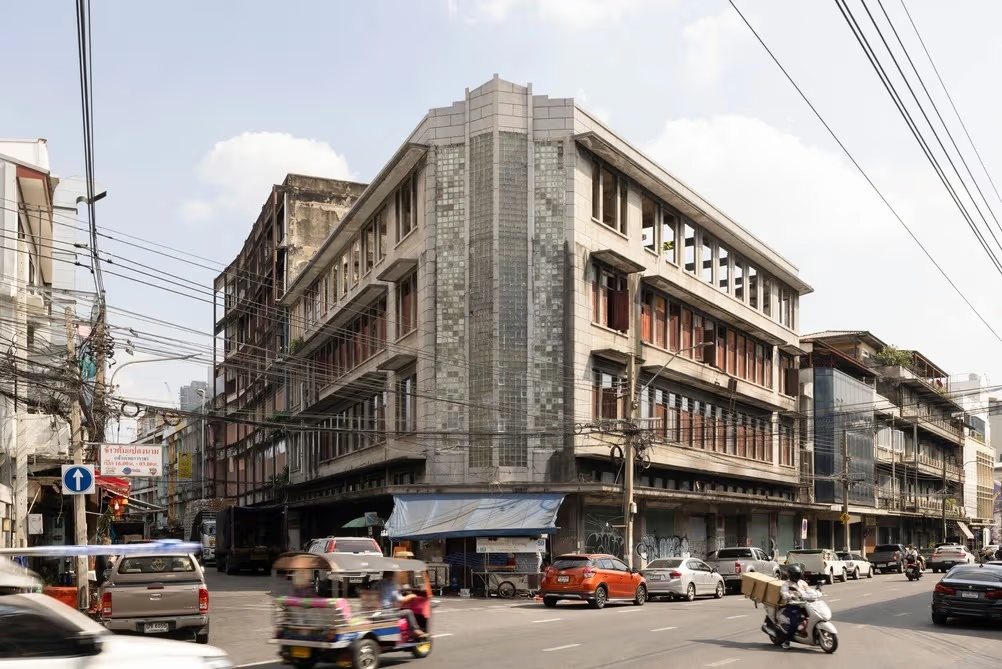
Let’s start with the Bangkok Kunsthalle, which is one of the most compelling new institutions shaping the trajectory of Bangkok’s contemporary art scene, signalling a broader shift toward experimentation, international dialogue, and alternative exhibition models. Established in 2024 and located in a partially preserved, fire-damaged industrial building in the historic Yaowarat (Chinatown) district, the Kunsthalle distinguishes itself through both its physical environment and its curatorial philosophy. Rather than restoring the structure into a conventional “white cube,” the space retains its raw, atmospheric character, inviting artists to engage directly with its material history, spatial fragmentation, and urban surroundings. While I was visiting, big parts of the building were occupied by large scale exhibitions, other spaces abandoned next to open rehearsals and activities such as a cooperate event for the Thai popstar Lisa or the Choreography Symposium, about which we will hear more later in the interview with Jitti Chompee. Parallel to these cultural events, the renovations were still in process, basically right next to each other. This rawness of transparent coexistence, and the emphasis on site-responsiveness, transforms the building itself into an active participant in the artistic process, aligning the institution with a movement toward immersive and context-driven practices.
As a kunsthalle—meaning it does not maintain a permanent collection—the institution focuses entirely on temporary exhibitions and newly commissioned works. This allows for more flexibility and risk-taking, encouraging artists to experiment with scale, medium, and concept without the constraints of collection-building or market pressures. The programming often spans multiple disciplines, including installation, performance, film, and architecture, reflecting the increasingly hybrid nature of contemporary artistic production. In this way, Bangkok Kunsthalle functions less as a repository of objects and more as a platform for ideas, research, and process-based work.
Its contribution to Bangkok’s art ecosystem is particularly significant in how it bridges local and international contexts. By collaborating with internationally recognized curators and artists, it positions Bangkok within a wider circuit of contemporary art discourse, while still grounding its projects in the specific cultural and spatial dynamics of the city. This dual orientation helps amplify local practices, offering them greater visibility and resonance beyond Thailand, while also attracting new audiences and forms of engagement.
At the same time, the Kunsthalle complements rather than replaces Bangkok’s grassroots energy. Its experimental ethos resonates with the city’s existing culture of adaptive reuse, interdisciplinary practice, and informal creative networks, but it operates at a different scale—one that allows for more resource-intensive, large-scale commissions and long-term curatorial research. In doing so, it raises the ceiling for what is possible within the local art scene. Ultimately, I see Bangkok Kunsthalle contributing strongly to the growing contemporary art scene in Bangkok by redefining what an art institution in the region can be: open-ended, process-oriented, and embedded in its environment.
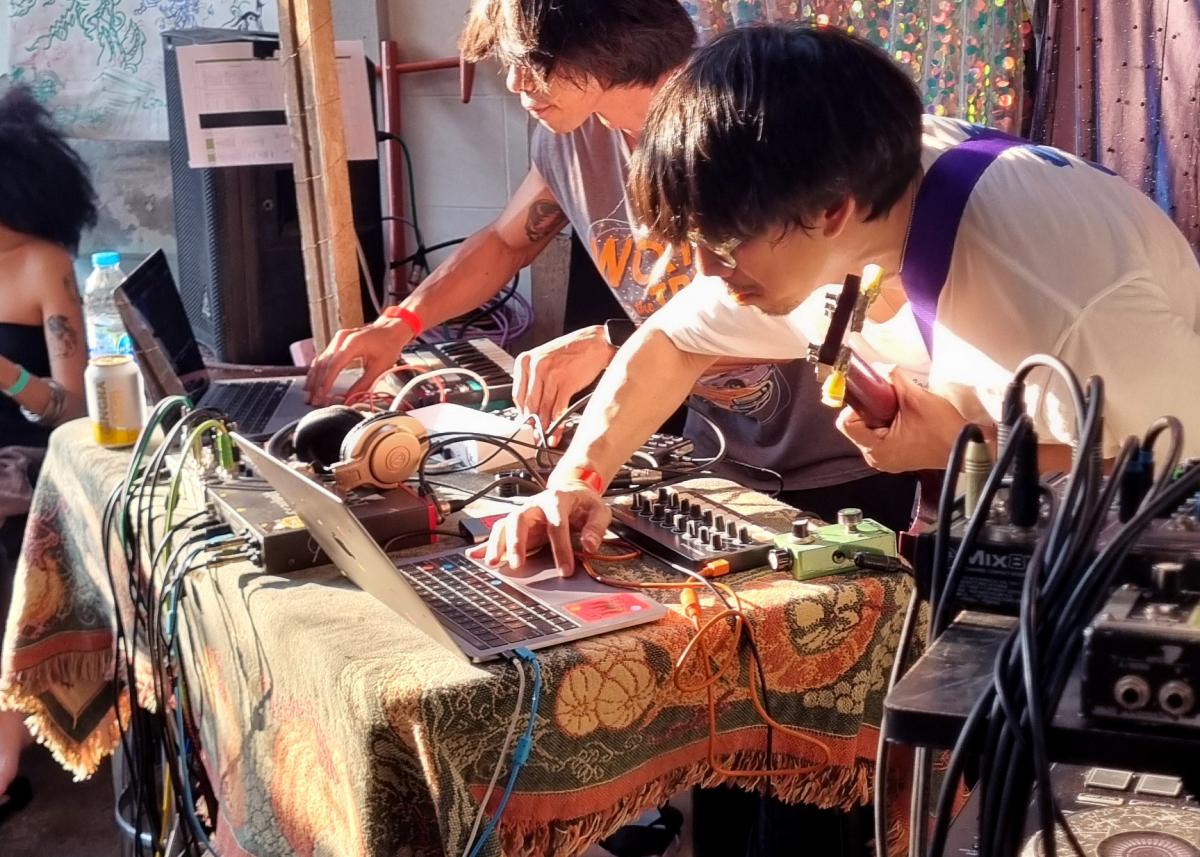
A completely different example is the small but highly influential grassroots space Noise House, which has played a key role in shaping the city’s experimental sound and interdisciplinary art scene. Located in the Lat Phrao area, it operates as a hybrid between a workshop, venue, and community hub, blurring the boundaries between production, performance, and social gathering. During the day, Noise House functions as a space for building, repairing, and experimenting with electronic instruments, while in the evenings it transforms into an intimate venue for live performances, ranging from ambient and noise to live electronics and audiovisual experimentation.
I had the chance to visit the final event, as the space had to close afterwards because of financial reasons. That event was a full day of many live concerts taking place parallel in two small rooms and a tiny backyard, packed with a sweating and enthusiastic audience and musicians.
Noise House had an emphasis on process and participation rather than polished presentation. It fostered a culture of openness through jam sessions, collaborative performances, and informal exchanges of knowledge, allowing artists, musicians, and technologists to test ideas in real time. This made it less a traditional venue and more an incubator for emerging practices, where the line between artist and audience is often fluid.
Within Bangkok’s broader contemporary art ecosystem, Noise House represented an important counterpoint to institutional and commercial spaces. It operated with a DIY ethos, relying on community energy rather than formal structures, and created opportunities for both local and international artists to connect outside of established circuits. Its scale—small, adaptable, and socially dense—contributed to a sense of immediacy and experimentation that is difficult to replicate in larger venues.
Despite its impact, Noise House also reflects the precarity of independent cultural spaces in Bangkok, where rising costs and limited structural support can make long-term sustainability challenging. Nevertheless, its influence extends beyond its physical footprint, contributing to a growing alternative network of artist-led initiatives that hopefully continue to redefine what contemporary art and sound practice can look like in the city.
A culture of choreographic thinking – an interview with Jitti Chompee
Dear Jitti,
we don’t really know each other, despite a few exchanged sentences during your Choreography Symposium in Bangkok, but from what I found online you seem to be a very active artist, who is also very engaged in setting up platforms for dance-related activities. To start with you founded the 18 Monkeys Dance Theatre, what’s the story behind the name?
18 Monkeys Dance Theatre was founded in 2010. The name actually came from my first company production, which was also called 18 Monkeys. The inspiration came from the Khon episode Kham Samut (Crossing the Ocean), where the monkey army helps carry stones to fill the sea so that Rama’s army can cross to Lanka.
For me this image was very powerful — many monkeys working collectively, each carrying a small stone, but together they make something monumental possible. I saw this as a metaphor for artistic collaboration and collective effort in the performing arts.
And you also founded the international performing arts platform Unfolding Kafka Festival, which is dedicated to strengthening Thailand’s contemporary arts ecosystem.
What role does one of the most important representatives of German-language literature of the 20th century and his descriptions of unfathomably threatening, absurd situations play in your understanding of performing arts?
The idea of the Unfolding Kafka Festival started as a small experimental model. My intention was actually quite practical: I wanted to study how to build a sustainable structure for contemporary performance in Thailand — learning about management, financial systems, and especially how to build a strong audience base.
I initially planned the project for about ten years. Unexpectedly, it grew into what became one of the largest contemporary dance festivals in Thailand and received strong support from international networks.
For me, the festival was a learning platform. It allowed us to experiment with what kinds of artistic work resonate with Thai society, how to stimulate movement and inspiration within the local performing arts community, and how to connect Thai artists with the international scene, especially artists working across disciplines.
After ten years, however, I began to feel that the festival had become too much of a business structure. That was not really my main interest anymore. So, I decided to stop the festival and move toward a larger and more focused model — concentrating specifically on choreography development.
If I understand correctly your most recent project and still in the making is the national choreography centre of Thailand, which sounds big, important and actually quite institutional.
On your website is says: “Furthermore, collaborations with educational institutions have been hindered by bureaucratic hurdles, inflexible systems, and excessive paperwork…“
I can very much relate to the frustrations dealing with slow and unflexible institutions. At the same time these frustrations were the strongest motivation for to start the project space NEW FEARS, a gallery in Berlin dedicated to body related practices and more intuitive and flexible artistic production. Of course, this independency comes with a price, which is usually a lot of work and little money. What are your main motivations for the choreography centre, what do you want to accomplish and what are your biggest struggles with it?
The motivation for the choreography centre comes from a long observation of the structural gaps in Thailand’s performing arts ecosystem. There are many talented dancers and artists, but there are very few platforms that support long-term artistic development, research, and choreographic thinking.
The centre is envisioned as a place dedicated specifically to choreography: research, development, dialogue, and exchange. It is not only about producing performances, but about building a culture of choreographic thinking.
One of the biggest challenges is institutional collaboration. As I mentioned on the website, working with educational institutions can be very difficult because of bureaucracy, rigid systems, and excessive administrative procedures. These structures are often not flexible enough to support artistic processes.
But at the same time, these struggles also clarify why independent initiatives are necessary. Like your project space NEW FEARS in Berlin, independence often means a lot of work with limited financial support, but it also allows more freedom to experiment and build new models.
On your website it says: “At a time when global attention toward Southeast Asia’s creative practices is rapidly growing, Thailand stands at a critical moment in redefining its contemporary performing arts infrastructure.“ Why do you think that attention is growing and what kind of infrastructure are you envisioning for Thailand?
I think global attention toward Southeast Asia’s creative practices is increasing because the region has very complex cultural layers — traditional practices, colonial histories, rapid modernization, and hybrid identities. Artists here are navigating these tensions in interesting ways.
However, infrastructure in many countries, including Thailand, is still developing. What I imagine is an ecosystem where artists can work more sustainably: spaces for research and rehearsal, funding systems that support experimentation, international exchange programs, and institutions that truly understand artistic processes.
Do you think that Thai choreographers/dancers look a lot outside of Thailand towards external/foreign criteria defining what contemporary choreography is supposed to look like? And if yes, what do you or other Thai choreographers see there outside?
Yes, many Thai choreographers look outward, especially toward Europe, because contemporary dance discourse has historically been centred there. Festivals, institutions, and funding systems in Europe have shaped certain expectations about what contemporary choreography should look like.
But I think what Thai artists often see outside is not only aesthetics, but also structures — how artists can survive, how artistic research is supported, and how institutions interact with artists. At the same time, there is now a growing awareness that we should not simply follow external criteria. It is important to develop our own context, our own questions, and our own choreographic languages.
Have you been working in the field of dance in Europe and if yes could you name some differences to Asia in the approach towards choreography and the understanding of the body?
Working in Europe, I noticed that there is often a strong emphasis on conceptual frameworks and artistic research. Institutions also tend to provide clearer structures for production and development.
In many Asian contexts, including Thailand, artists often work with fewer resources but with strong adaptability. The relationship to the body can also be different because traditional forms still influence how the body is understood, even within contemporary work.
These differences are not necessarily better or worse — they simply reflect different cultural and institutional environments.
Which was the last artistic work that really moved you and why?
Recently I have been very interested in works that question the role of choreography itself — works that move beyond movement and consider choreography as a broader system of relations: between bodies, time, space, and society. What moves me is not only virtuosity, but when a work opens a new way of thinking about how we organize movement and experience.
Do you think it would be desirable and helpful to have one common worldwide understanding of contemporary choreography?
I don’t think it is necessary or even desirable to have a single global definition of contemporary choreography. Choreography should remain plural and contextual. Different cultural environments will always produce different approaches to the body and movement, and that diversity is what keeps the field alive.
The fetish for the new has been and is still a strong force in the arts. Why do you think reinvention and progress is necessary? Do you think new is always good?
The desire for the new has always been a strong force in the arts. But I don’t think “new” automatically means better. Sometimes progress in art comes from reinvention, but sometimes it comes from deepening existing knowledge or revisiting traditions in new ways. What matters is not novelty itself, but whether the work opens meaningful questions.
What is your dream-scenario for the dance-scene in Thailand?
My dream is to see a stronger ecosystem for choreography in Thailand — where artists can develop their work overtime, where research is valued as much as production, and where younger generations have access to platforms that support experimentation.
I also hope to see stronger connections between local practices and the international community, but in a way that allows Thai artists to define their own voices rather than adapting to external expectations.
The interview was conducted on March 12, 2026
Written by July Weber
Choreoblog
A place for discussion and sharing, the blog for Master’s Degree Programme in Choreography brings together students, staff, and visitors to write and read about choreography, studying, ongoing projects, (dance) art, and related topics.
Latest posts
-
In the Space Between Knowing and Becoming - Notes on an Artistic Collaboration Project
-
Misbehaving with Classical Ballet – Why Study Theory at Uniarts?
Follow blog