
Pinja Nuñez: Echoes of War and Peace – Arrangements and Compositions for Cello
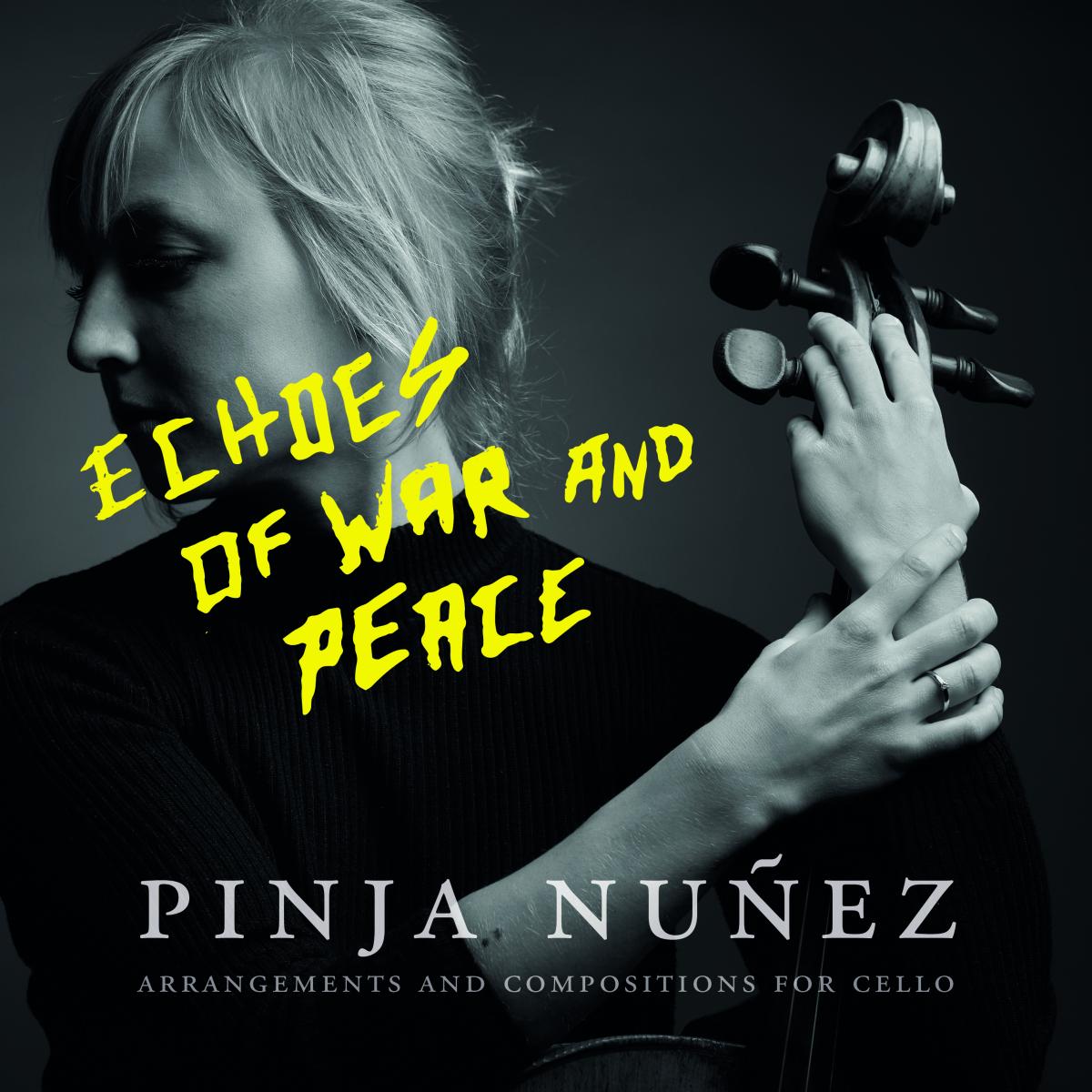
- Jaakko Paarvala, photo
- Petrina Laine & Antti Karvanen, cover and graphic design
- Anders Pohjola, sound designer
- Kati Raitinen, producer
- Pinja Nuñez, artistic planning, arrangements, composition and cello
- All recordings were made at the Helsinki Music Centre Organo-hall in December 2024 and May 2025.
A brief introduction to my artistic doctoral thesis
My artistic doctoral thesis reflects on the relationship and interaction between art and society, especially from a performing artist’s point of view. I am fascinated in how the social meanings of Western art music are created and how the prevailing social situation affects artists and their artistic production. Creative work cannot be separated from society. My doctoral project has made me think that as a musician I am an active and influential member of society who has a responsibility to observe artistic work also from a social perspective.
The concert series (2017–2022) that was part of my artistic doctoral degree consisted of five concerts that approached the social aspects of classical music from five different perspectives:
- Sounds from the Soviet Union (2017)
- Ravages of war – compositions from concentration camps (2019)
- What if everything relates to everything – the role of women in classical music (2020)
- The sacred society – religions and spiritualism in music (2021)
- Art rebellion – values transmitted by art (2022)
Of these five recitals, in particular the third one (in which I discussed the role of women in the context of Western art music) and the fifth one (in which I considered the values transmitted through the tradition of Western art music) gave me the opportunity to explore the social impact of Western art music through my own artistic work. This inspired me to delve into the topic in my written thesis that is part of my artistic doctoral degree.
In my written thesis Does gender matter? Perspectives on equality issues in Western art music in Finnish higher education in music, my aim is to highlight gendered structures in the Western art music education. I aim to analyze the pedagogical processes that produce and maintain gender differences and gendered power relations. I present two reviews of the gendered structures in classical music education. Firstly, I examine how gender inequality is constructed in the educational practices of the Sibelius Academy Strings Department, and how these practices reflect the gendered structures prevailing in the field of Western art music. Secondly, I seek to describe how the gendered inequality of Western art music culture has influenced my own experience, artistic thinking and identity as a musician. I argue that the manifestation of gender inequality in Western classical music education is a structural problem that should be acknowledged when developing educational content.
Musical practices recycle stereotypical gender definitions, which often convey a very normative image of gender and (hetero)sexuality. In the Strings Department of the Sibelius Academy, instrumental teaching still focuses on the romanticized concept of a musical work and thus certain standardized works composed by canonized male composers. Furthermore, the official canon is often presented as neutral and self-evident, even though its construction has been influenced by social and cultural values and practices.
Read more at urn.fi/URN:ISBN:978-952-329-424-0
The album Echoes of War and Peace – Arrangements and Compositions for Cello
One of the main goals in my doctoral research was to expand the traditional classical cello repertoire by playing music that has remained more or less unknown due to social circumstances, by making arrangements of pieces that might not be performed otherwise, by composing and by ordering a commissioned work. In this way, I tried through my own example to demonstrate alternative canons and question the repetition of canonized works in Western art music education and performance practices.
The album Echoes of War and Peace – Arrangements and Compositions for Cello highlights the arrangements and compositions from my doctoral concert series.
The album is divided into two parts:
The first part, ECHOES OF WAR AND PEACE, presents compositions created amidst or influenced by war and persecution. At the same time, it is my personal tribute to humanity and the power of creative work.
Myroslav Skoryk (1938–2020): Cello Concerto (1983), for Cello and Chamber Ensemble arr. Pinja Nuñez
- Pinja Nuñez, cello
- Eeva Oksala, violin
- Maria Puusaari, violin
- Riitta-Liisa Ristiluoma, viola
- Tomas Nuñez, cello
- Kati Salovaara, double bass
- Malla Vivolin, flute
- Veera Myllyniemi, clarinet
- Tero Toivonen, french horn
- Tuukka Vihtkari, bassoon
- Kazutaka Morita, percussion
- Salla Pynssi, piano
- Jozsef Hars, conductor
Viktor Ullman (1898–1944): Drei jiddische Lieder op.53 (1944) Part I Berjoskele, for three cellos arr. Pinja Nuñez
- Pinja Nuñez, cello
- Tomas Nuñez, cello
- Samuli Peltonen, cello
Aleksander Weprik (1899–1958): Kaddish op.6 (1925), for Cello and Accordion arr. Pinja Nuñez & Harri Kuusijärvi
- Pinja Nuñez, cello
- Harri Kuusijärvi, accordion
Frank Bridge (1879–1941): Lament (1912), for two cellos arr. Pinja Nuñez
- Pinja Nuñez, cello
- Tomas Nuñez, cello
Pinja Nuñez (1987): Arrangements of Yiddish Folk Songs (2019) for Chamber Ensemble
- Pinja Nuñez, cello
- Eeva Oksala, violin
- Riitta-Liisa Ristiluoma, viola
- Kati Salovaara, double bass
Mikhail Yakovlev (1798–1868): Elegy, for two cellos & accordion arr. Pinja Nuñez
- Pinja Nuñez, cello
- Tomas Nuñez, cello
- Harri Kuusijärvi, accordion
The second part, ART, IT IS SPEAKING, approaches music as a social force for change. Who gets a voice in the canon of Western art music? Who will stay on the sidelines, what are the themes that remain unspoken?
Pinja Nuñez (1987): Häpeä (Shame) for solo cello (2020)
- Pinja Nuñez, cello
Elisabeth Maconchy (1907–1994): Ophelia’s song (1930), for two cellos and soprano arr. Pinja Nuñez
- Olga Heikkilä, soprano
- Pinja Nuñez, cello
- Tomas Nuñez, cello
Max Savikangas (1969): Art Rebellion – After the Party (2022) for reciting cellist
- Pinja Nuñez, cello
Pinja Nuñez (1987): Overture Inspired by Opera Deaths (2022) for two cellos and soprano
- Olga Heikkilä, soprano
- Pinja Nuñez, cello
- Tomas Nuñez, cello
Gioachino Rossini (1792–1868): Theme and Variations (1819), for cello and string quintet arr. Pinja Nuñez
- Pinja Nuñez, cello
- Eeva Oksala, violin
- Maria Puusaari, violin
- Riitta-Liisa Ristiluoma, viola
- Tomas Nuñez, cello
- Kati Salovaara, double bass
A brief introduction to the works
Myroslav Skoryk was born on July 13, 1938, in the city of Lwow, now known as Lviv, Ukraine. In 1947, during the post-war Stalinist wave of arrests, the Skoryk family was arrested and deported to Siberia, where Skoryk spent his childhood. As a composer, Skoryk has been deeply interested in Ukrainian musical folklore. The cello concerto was composed in 1983 for symphony orchestra. I have arranged the concerto for cello and chamber ensemble.
Viktor Ullman composed The Three Yiddish Songs, of which Berjoskele is the first part, just before he was moved from Theresienstadt to the Auschwitz concentration camp, where Ullman died in the autumn of 1944. The style of the songs is unusual compared to the composer’s other work: there is no surviving evidence that Ullmann had composed or arranged Jewish music before his time in Theresienstadt. These folk music arrangements therefore seem to represent an output that is uniquely part of Ullmann’s life in captivity. I have arranged Ullmann’s lied for three cellos.
The words of Berjoskele come from the Jewish songbook Jüdische Liederbuch, published in Berlin in the 1930s.
Little Birch
Quietly, quietly, my sweet white little birch shakes its green foliage
and prays without end;
its every leaf whispers a silent prayer.
Pray now, little birch, pray for me!
In your thin branches, a soft, rose-colored beam of light
reflects from the far west,
its light kisses have touched your delicate leaves,
leaves that were still asleep listening to the nightingale.
A gentle breeze blows from the open field
telling your little leaves endless stories,
deep in my heart I long for something.
Pray now, little birch, pray for me!
(translation by Pinja Nuñez)
Aleksander Weprik was born on June 23, 1899 in Balta, Russia, in what is now Ukraine. Weprik is considered one of the most important representatives of the “Jewish school” in Soviet music. In 1950, as anti-Semitism increased in the Soviet Union, Weprik was arrested for “Jewish nationalism”. Kaddish or Poem (op.6) was composed in 1925, during the golden age of Jewish-influenced music.
”Kaddish” is a hymn praising God that is recited during Jewish prayer services. The central theme of the Kaddish is the magnification and sanctification of God’s name. The work was originally composed for voice and piano. I have arranged it for cello and accordion together with accordionist Harri Kuusijärvi.
Lament (a passionate expression of grief ) for two violas, is an early, pre-war work by FRANK BRIDGE (1879–1941). It was originally composed for him and the violist Lionel Tertis to be performed at the Wigmore Hall in March 1912. There were two pieces – Caprice and Lament – the first of which has been lost. Paul Hindmarsh has compiled a sheet music edition of the original sketches, on the basis of which I have arranged a version for two cellos.
Elegy, to which the poet Anton Delvig wrote the words, is one of the most famous vocal works of the Russian composer Mikhail Yakovlev (1798–1868). I have written an arrangement of the Elegy for two cellos and an accordion.
Elegy
When, soul, you begged,
For death or love,
When hopes and dreams
Rushed to you
When I had not yet drunk tears
From the bowl of existence, –
Why then, in a wreath of roses,
Did I not disappear into the shadows?
Why did you,
Songs of bygone times,
Leave such a great mark on my memory
– The only sign of youth.
Bitterly I forgot the valleys, the forests
And the beloved gaze too!
But why do my ears hear these sounds,
Why can’t I forget?
You cannot bring me back happiness,
Although it still lives in your tunes
In times gone by,
I said goodbye to happiness long ago.
I pray, do not disturb
My soul’s sleep
Oh songs,
Do not repeat to my soul the frightening word
”love”.
(translation by Pinja Nuñez)
The Arrangements of Yiddish Folk Songs are based on violinist and composer Jonathan Keren’s (1978) interpretations of the songs Dremlen feygl af di tzvaygn, Shtiler shtiler lomir Shvaygn and Yisrolik. The arrangement has folk music influences, but it sits at the crossroads of several different musical styles.
Häpeä (Shame) variations are based on the bass line of Barbara Strozzi’s (1619–1664) song Che si puo fare (What can be done). One after another, the variations hit the glass ceiling until the theme finally closes the work. Shame is the theme of the poem entwined between the variations. I have often felt a kind of shame about my womanhood if it has been lifted up. I believe it derives from a strong ideal of asexuality, still persistent in the circles of classical music: a woman is somehow more successful when her sex is not mentioned. Creating a feeling of shame is an efficient and powerful tool. Facing one´s own shame is connected, I believe, with fear of not being sufficient, of being defective, and with accepting one´s inadequacies. Performers are encouraged to translate the poem to their native language.
Shame
Ashamed of being a woman.
Ashamed even for men.
Ashamed of us not just being human beings.
Ashamed of practicing too much – all should come by itself, if one is good enough, that is.
Almost unbearable shame when practicing something new, something I can’t play yet.
Would rather not practice, or just play something I already know,
but then there would really be no need to practice any more.
Ashamed of being called conscientious.
It makes me feel that I am good only because I am persistent,
not for really having something to say.
Ashamed of fixing myself too much before a performance. What am I trying to achieve?
Ashamed if attention is paid to my appearance. And yet I am on stage to be looked at, to be evaluated,
an object.
Ashamed even if everything is ugly.
Ashamed of not being able to change things, only repeating what has been said to me. Everything repeats. Ashamed for at times not believing that anything changes.
(Written by Pinja Nuñez)
Elizabeth Maconchy (1907–1994) was a British composer whose extensive output includes chamber and orchestral works, vocal music, three ballets, five operas and an operetta. Ophelia’s Song, composed in 1930, is based on Shakespeare’s poem. Hamlet’s lover, Ophelia, who represents feminine sorrow and madness, is one of Shakespeare’s most famous female characters. After being abandoned and betrayed by her lover, Ophelia drowns in a river. Ophelia’s aestheticised and romanticised death is ultimately greater than her life. I have arranged the work, originally written for piano and soprano, for two cellos and soprano.
Hamlet (Act IV, Scene 5)
How should I your true love know
From another one?
By his cockle hat and staff,
And his sandal shoon.
He is dead and gone, lady,
He is dead and gone;
At his head a grass green turf,
At his heels a stone.
White his shroud as the mountain snow,
Larded with sweet flowers;
Which bewept to the grave did go
With true-love showers.
Art Rebellion – After the Party is a commissioned work by composer Max Savikangas (1969).
The texts to be recited by the cellist are from an article entitled After the Party by Sonja Saarikoski, which was published in the Finnish Image magazine in February 2020. The text was also published in English, translated by David Hackston. The article was awarded the Paulo Hulda price. The theme of the article is sexual harrasment in music instrumental teaching.
The text recited by a cellist
How many people in the audience realise they are about to witness a form of violent entertainment?
I don’t believe in anything but music, she wrote. It was her religion.
Bad behaviour and transgressing boundaries is possible when you don’t realise how other people see you.
The idea that some individuals are exceptional is part and parcel of classical
music, the idea that there have always been people who are naturally more gifted than others.
They say that music starts from silence.
Tradition is just one story among many, and it isn’t always a very good story. This
isn’t the best of all possible worlds!
We only realised slowly, over time. And as time goes by, we realise all the more.
Ultimately, we realise that something needs to change.
And to bring about such change, do we need a scapegoat that we can stone?
Of all possible candidates, who might it be?
Teachers only fall in love with the prettiest, most talented students, I thought.
Somehow they have ended up with the impression that the antidote to bad self-esteem
is picking up a young woman.
The truth is shaped in relation to time: those who know the right people at a*
particular moment and speak their language garner the most attention.
Nobody wants a revolution when they themselves are in power.
We return to things left behind us until someone or something makes it possible
for even painful memories to change and become memories like any other. Then
they evaporate, transform into shapeless images.
How could I have been so stupid that I actually thought I was talented.
”My beliefs forbid female priests and conductors”
(Written by Sonja Saarikoski)
Overture Inspired by Opera Deaths for two cellos and soprano by Pinja Nuñez (1987), draws its musical inspiration from musicologist Susan McClary’s analysis of the musical act. I am fascinated by the power of McClary’s writing style and her use of musical metaphors, which I find almost poetic. The playful overture that consists of both spoken and vocal parts, aims to reflect on the caricatured image of women in Western opera. The subject is approached in particular through the themes of madness and hysteria, as the socially perceived differences between man and woman have traditionally been condensed into differences between rationality and irrationality. What would happen if the female characters got their own voice? If female characters lose their caricatured, passive roles, is there anything left? Or maybe when the thin stereotype of femininity has been taken away, something much more is revealed?
The lyrics of the Overture
Soprano: In opera, men statistically die slightly more often than women. Men are usually stabbed. Women die violently too. But women also die of grief, or commit suicide by poison or drowning. Usually because of a man.
a woman recites: In a tragic operatic love story, the woman usually dies if her lover perishes. Conversely, if the woman dies first, the male lover often survives and continues his life.
Death Aria
Amo la vita (I love life)
Tutta bellezza (All beauty)
Amo le notti (I love the nights)
Amo i giorni (I love the days)
Amo la vita (I love life)
Un giorno tutto finirà (One day everything will end)
Ma oggi (But today)
Non voglio morire (I don’t want to die)
Amo la vita (I love life)
Lasciatemi vivere (Let me live)
Ancora domani (Still tomorrow)
a man recites: The death of mad women in opera is a necessity. A woman can only survive madness if she is innocent and naive enough, and if a man saves her.
Recitativo
The external signs of hysterical women are the same in almost all forms of art.
Hysterical women have loose hair that reflects loose sexual morality, and staring eyes, in contrast to respectable women who lower their gaze.
They wear something white, preferably a nightgown, and they have bare feet.
They combine sexuality and naivety, the stereotypes of the angel and the whore.
Aria of Madness
Did you know that hysteria comes from the Greek word hystera (” a womb”).
In ancient times, it was thought that hysteria was caused by the uterus shrinking or moving into the wrong position.
Hippocrates recommended getting married as a cure for hysteria.
Hysteria was later also treated with hysterectomy: a removal of the uterus.
a woman recites: In 19th-century Europe, madness was fashionable, and people went to marvel at it like it was a circus. The diagnosis of hysteria was used to explain just about everything related to women. The textbook hysteric is a childish, emotionally overreactive, and on the other hand, hyperfeminine, erotically attractive woman. The stereotype of the hysterical woman has served as an inspiration for numerous artists.
a man recites: Paradoxically, when madness and sexuality are combined to a man, he becomes a genius.
Soprano: Deaths are liberating and rewarding to perform on stage. Death provides a climax to the story, and the death arias are usually wonderful.
Rapes are much more difficult to perform.
Actually, all the characters I’ve played this season died.
(written by Pinja Nuñez)
Gioachino Rossini (1792–1868) was an Italian composer, best known for his operas. The music I have arranged for cello and string quintet is based on Rossini’s Theme and Variations, originally written for clarinet and orchestra. This final work of my album is like a miniature opera in which the cello is playing the leading role.
Main sources
- Nemtsov, Jascha. 2008. Judische Musik. Studien und Quellen zur judischen Musikkultur. 374–386. Wiesbaden: Harrassowitz Verlag.
- Nemtsov, Jascha. 2008. The Scandal was perfect. Jewish Music in the Works of European Composers. 117–142. Online source: https://www.zeitschrift-osteuropa.de/site/assets/files/4008/oe081008.pdf
- Fackler, Guido. Theresienstadt. Music and the Holocaust. ORT. Online source: http://holocaustmusic.ort.org/places/theresienstadt/
- Zabelsky A.K. Jennifer. 2015. Viktor Ullmann’s Terezín lieder: a performance guide to songs for soprano or high voice. Boston University College of Fine Arts.
- McClary, Susan. 1991. Feminine endings. Music, gender and sexuality. Minnesota: The University of Minnesota Press.
- Kortelainen, Anna. 2003. Levoton nainen. Hysterian kulttuurihistoriaa. Jyväskylä: Gummerus Kirjapaino Oy.
- Launonen, Krista. 2018. Ofelian suru. Vantaa: Kirjastopalvelu Oy Avain.
- Saarikoski, Sonja 2021. Image 02/2020. After the Party. Online source: https://www.apu.fi/artikkelit/sexual-abuse-and-humiliation-in-finnish-classical-music-scene
Levyvihkon lisälehdet
Sibelius-Akatemian oma levymerkki SibaRecords tuottaa korkeatasoisia levyjä ja vie niiden välityksellä maailmalle opettajiemme ja opiskelijoidemme musiikkia. Tässä blogissa pääset tutustumaan yksittäisiin julkaisuihin sekä tekijöihin niiden takana. Levymerkistä voit lukea lisää myös verkkosivuiltamme www.uniarts.fi/yleistieto/sibarecords/
Uusimmat julkaisut
Seuraa blogia