
The Treasure Hunt Album: sowing ideas, the score as soil, a collaborative harvest of sounds
In this blog post, doctoral student Livia Schweizer reflects on the journey of her album Treasure Hunt, which is a part of her doctoral degree at the Sibelius Academy.
Go outside, listen to the space.
Choose materials, sounds, textures that attract your attention…could they become the beginning of a musical score?
Can a bunch of seeds found in a botanic garden become the beginning of an exchange of ideas, sounds, stories, and then transform into a musical piece?
When we look at a musical score, we often expect a set of fixed instructions, a document telling us how the music should sound. But what happens when we have as a score something that reminds of a map, a series of clues, or an invitation to a shared journey? What happens when the score is open and ambiguous?
For example, what would you do if this would be the piece in front of your music stand?
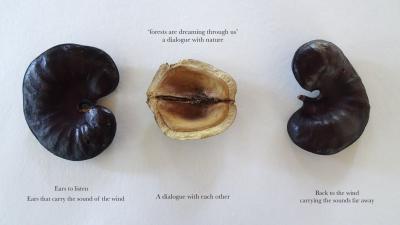
A trial score done during the workshop in Brazil, October 2025
This album, Treasure Hunt is both a result and a starting point of my doctoral research. It is an album that investigates how ”open scores” and collaborative score-making can serve as catalysts for human connection, shared agency, and intercultural dialogue.
The project grew out of a collaborative residency in Natal, Northeast Brazil. Over three days outdoors. Surrounded by towering trees, unfamiliar birdsong, large iguanas falling from branches, and the natural rhythm of the space I had the wonderful opportunity to facilitate a workshop with a group of local musicians, colleagues, and friends that I had first met them in the beautiful and hot city of Caicó during a community project organized by the Global Music Department in the spring of 2025. Luisa, Auri, Bárbara, Pamella, Ana, and Mariana, became the composers and collaborators on this journey. During the workshop, we listened to the space around us and walked following simple prompts I had written, much like a treasure hunt. Between sounds, we shared Brazilian snacks (Oh I miss those!!), tried together some of Pauline Oliveros text scores, talked about Paulo Freire, and learned about one another through talking, while listening and collecting materials from the ground of a garden of the University of Rio Norte do Grande.
Ideas started to unfold, noticing how each seed we collected somehow evoked something in us, and between stories and sounds, the scores for this album took shape.
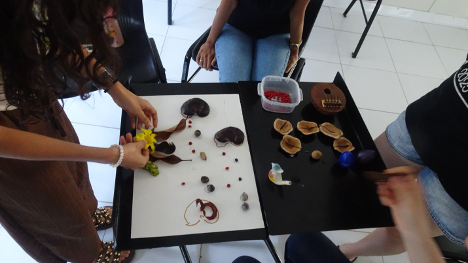
Making the scores, here Luisa assembling her score
Real and metaphorical seeds traveling from Natal to Helsinki
After the workshop, with the photos of the scores done in Brazil in that wonderful garden, with some videos, audio memos, new precious memories and many notes I traveled back to Helsinki with the idea to make an album recording where with Adriano Adewale as a colleague and sonic explorer I would present an interpretation of the scores done together in Brazil. Adriano led the community project in Brazil where I met all the women who joined me in this adventure, so bringing us all together in a new form felt deeply meaningful.
The working group slowly expanded: Simone Spampinato joined for live electronics, mixing and as recording engineer, and Nathan Riki Thomson joined as a guest to play in the only text score that I wrote for this project.Oh yes, there is something truly special when your doctoral supervisor joins the creative process, becoming part of the journey.
Together with Adriano, I explored the scores and videos from Brazil, and we began shaping our own interpretation. Improvising, conversing via zoom, conversing and playing late in the evening in Musiikkitalo, and testing different approaches to the same images started a new journey of exploration: flutes, berimbau, seeds, and our voices became the tools we used to navigate these open maps. Storytelling, improvisation, memories and our musical languages met through the scores done by our dear composers / creators.
When Simone joined, a new dimension emerged through live electronics, giving us the chance to expand time and space.
Step by step, looking back, I can see how each collaborator influenced the final result. When working with open forms, hindsight reveals how choices were made and how interdependent everything truly is. The stories and scores created in Brazil traveled to Helsinki, and our interpretations and recordings are a crystallization of a specific moment of sonic exploration shared with Adriano, Simone, and Nathan inside the dear space of Toinen Kerros…another site dedicated to community making in Helsinki!
Within an open form, every choice reverberates. The music recorded here is not a final or definitive version of a piece, but a living document of real-time interdependence, a reminder of how open forms reveal both limits and unlimited possibilities.
What is the treasure?
Sometimes the treasure is finding a seed, shaped like a monkey’s ear, hidden in the dirt. Sometimes it is hearing a story that wakes what has been sleeping inside you.
Sometimes it is a small object or a word that pulls a childhood memory back into the light, or finding yourself in a hidden park only because your plans fell apart.
The treasure is realizing it is enough to sit in an empty room and see that the sky is plenty. It is enough to write a line that makes someone else sing.
The treasure is creating that sound where you meet with the other, realizing that we are more than the sum of our parts.
The treasure is a listening ear, and the person beside you who begins to resonate, too.
The treasure is knowing that a whole world of meaning can be carried by a single tiny seed, a word, or a sound. It is the way we walk into that world together, learning how we belong to one another. The treasure is cultivating curiosity and an open mind, keeping the path ahead of us open and fertile.
If you want to hear our version of these open scores, here is the Treasure Hunt Album in bandcamp
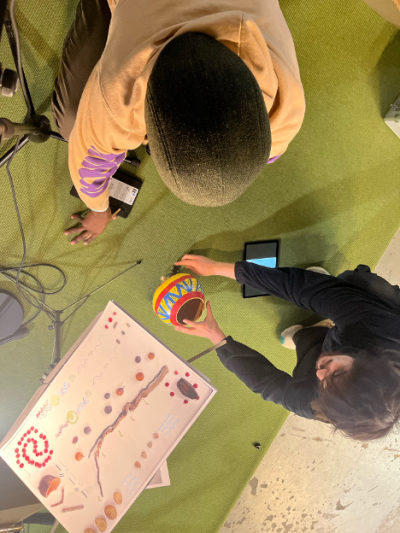
Adriano Adewale & Simone Spampinato during the recording
This album is dedicated to the young girls and the community of the Orquestra Aldo Parisot in Caicó, and to my friend and colleague David Souza: you opened my ears and created the perfect environment in which to plant the first seeds of this project. Those days in Caicó, with the sounds we listened to and made together, were the very first drops of water that helped the seeds behind this album. To the legacy of Pauline Oliveros, whose work continues to show us how listening can build community. To the texts of Paulo Freire and Gianni Rodari, which traveled with me in my luggage and my mind throughout this entire process.
Levyvihkon lisälehdet
Sibelius-Akatemian oma levymerkki SibaRecords tuottaa korkeatasoisia levyjä ja vie niiden välityksellä maailmalle opettajiemme ja opiskelijoidemme musiikkia. Tässä blogissa pääset tutustumaan yksittäisiin julkaisuihin sekä tekijöihin niiden takana. Levymerkistä voit lukea lisää myös verkkosivuiltamme www.uniarts.fi/yleistieto/sibarecords/
Uusimmat julkaisut
Seuraa blogia