
Seeing the child beyond the musical gift: Reflections on two research milestones
What can children gifted for music teach us about the strengths, contradictions, and ethical blind spots of music education? Drawing on nearly five years of international research, this post reflects on two recent milestones: an international research report examining how specialist music institutions balance excellence and care, and an invited filmed keynote address exploring how gifted children can become both exceptionalised and erased. Their experiences reveal vulnerabilities and educational needs that often remain invisible behind extraordinary abilities. As the research project approaches its final year (2027), these insights invite us to rethink how educational systems can nurture exceptional potential while caring for the whole child.
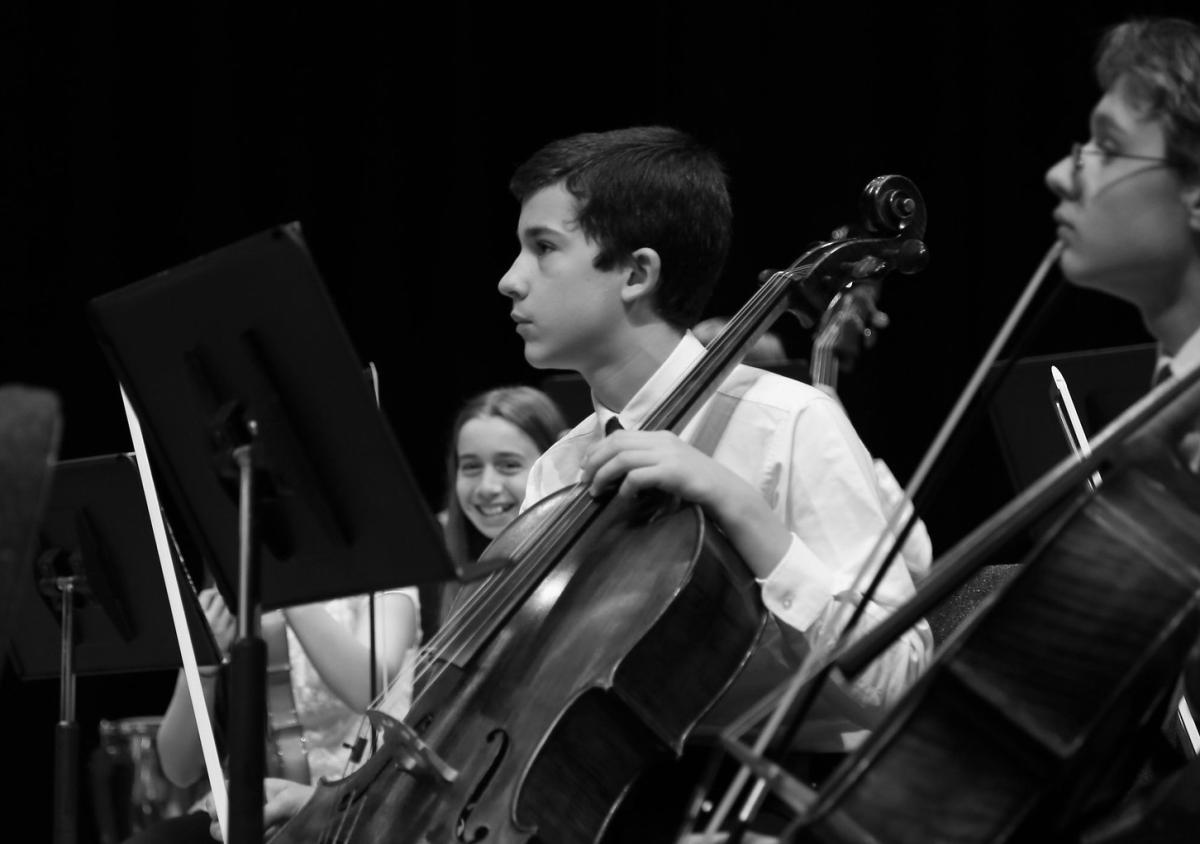
Over the past four and a half years, I have had the privilege of listening to children gifted for music, their families, teachers, former prodigies, institutional leaders, and many others involved in the development of exceptional musical abilities. These encounters, across countries, cultures, and educational traditions, have challenged my assumptions, deepened my understanding of giftedness and talent in music, and made me increasingly aware of how complicated caring for exceptionally able children can be.
Why focus specifically on gifted children? Because their experiences offer a particularly revealing lens through which to examine music education as a whole. Their exceptional abilities can accelerate educational trajectories, intensify expectations, and bring them into contact with multiple institutions and adults, often long before they have the maturity or autonomy to navigate these worlds independently. They can make visible the tensions between artistic excellence and educational responsibility, individual needs and institutional priorities, and children’s rights and adults’ ambitions.
Paradoxically, however, these children are often assumed to need less care precisely because they are so capable. Their extraordinary musical achievements can conceal very ordinary childhood needs, while their exceptional abilities may themselves remain unrecognised or unsupported. Their experiences therefore reveal not only what our educational systems do particularly well, but also what those systems struggle to notice.
My Research Council of Finland project, The Politics of Care in the Professional Education of Children Gifted for Music, will continue until August 2027, and there is still much to investigate, write, and share. Nevertheless, this autumn has brought two particularly meaningful milestones that I would like to share here.
From talented musician to whole child: What institutions can teach us about care
The first is a research report, “From Talented Musician to Whole Child”, developed with my dear colleague and collaborator Prof. Gary E. McPherson from the Melbourne Conservatorium of Music at the University of Melbourne.
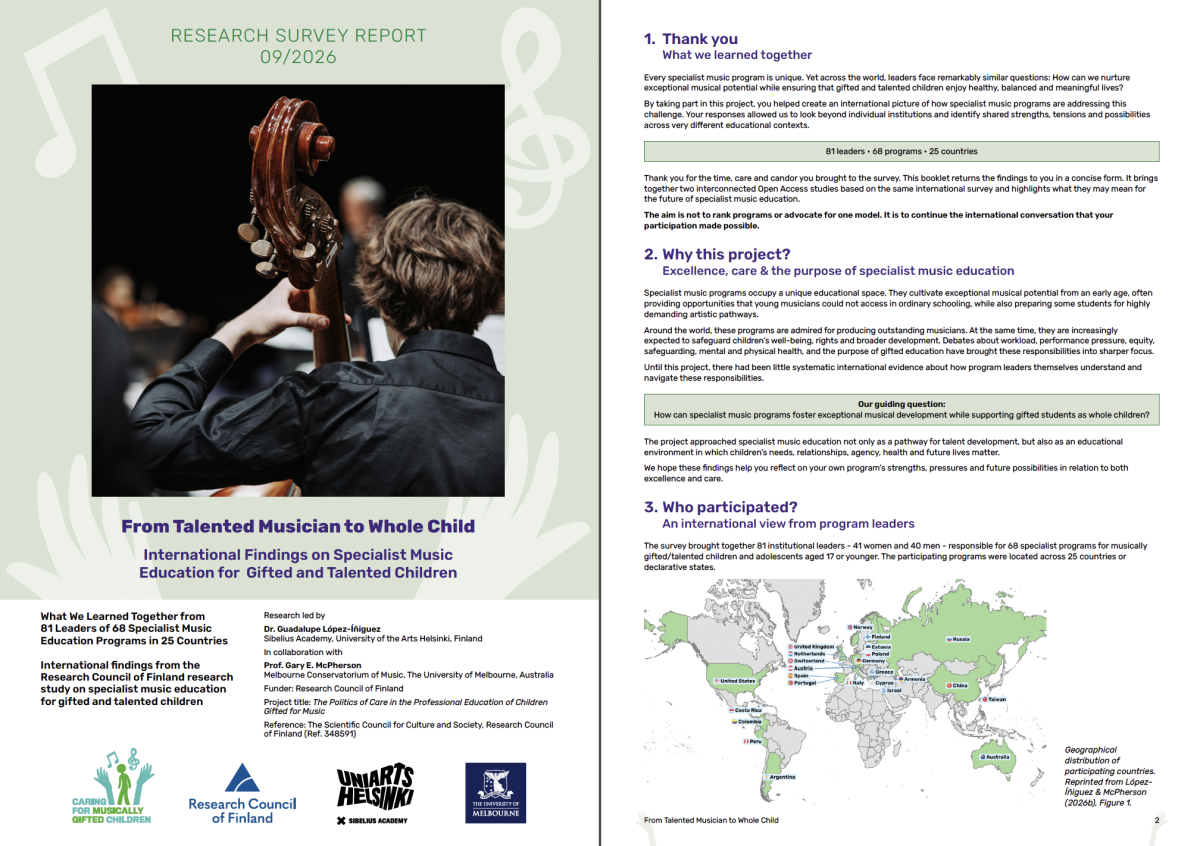
Drawing on two Open Access survey studies involving 81 leaders of 68 specialist music programmes across 25 countries, the report brings together what we have learned about the opportunities, challenges, and responsibilities of music institutions educating highly gifted and talented children around the world (López-Íñiguez & McPherson, 2026a, 2026b).
As I already discussed in a previous blog entry, one finding has stayed with me: the tension between educational systems designed to serve gifted children’s development and systems in which gifted children, however unintentionally, come to serve institutional ambitions, traditions, and expectations.
Our research also revealed a great deal of commitment and care among educational leaders. Indeed, specialist programmes can provide life-changing opportunities for children whose abilities and educational needs might otherwise remain misunderstood or unsupported. The challenge, therefore, is not simply to ask whether institutions care, but how care becomes embedded in their structures, relationships, and everyday decisions.
Gifted children are particularly revealing in this respect. Their education frequently involves an unusually complex network of teachers, schools, conservatoires, families, competitions, and professional opportunities. Each part of this ecosystem may be functioning well on its own, while nobody takes responsibility for the child’s experience as a whole. In this sense, gifted children can expose the limits of educational systems that are highly effective at developing talent but less equipped to coordinate care.
Exceptionalised and erased: The ethical cracks of music education
The second milestone is my filmed keynote address, “Musically Gifted Children, Exceptionalised and Erased: Care Ethics Amid the Ethical Cracks of Music Education”, prepared for the 4th European Music & Art School Symposium, hosted in Vienna’s mdw university in September 2026.
For this keynote, I wanted to do something different. Rather than presenting a conventional academic lecture, I invited the audience on a walk through Helsinki, connecting places, sculptures, and stories with findings from my wider international research involving nearly 200 people across five continents.
Several related studies also helped shape the questions I brought to this keynote. They examine music competitions as systems of care and strain (López-Íñiguez, 2026b), children’s exposure and visibility on social media (López-Íñiguez, 2026a), possibilities for systems change in gifted music education (López-Íñiguez & Sagiv, in press; López-Íñiguez & Westerlund, in press), the special needs gap in music education (López Cruz et al., in press), and the recognition and enactment of musically gifted children’s legal rights (Rautiainen et al., in press). Taken together, these strands of empirical research have deepened my conviction, grounded in the evidence, that caring for gifted children requires attention not only to individual relationships, but also to the wider systems that shape their opportunities, pressures, visibility, and rights.
The keynote reflects on a paradox that has become increasingly important to me: gifted children can become invisible precisely because their abilities are so visible. Their achievements, potential, and exceptional performances may overshadow their needs as children. A child capable of performing at an extraordinary level may be expected to cope with adult-like pressures, responsibilities, and workloads, even though their emotional, social, and physical development continues to follow its own course.
Yet gifted children can also become invisible in another direction: when educational systems, sometimes in the name of inclusion, anti-elitism, or anti-ableism, hesitate to recognise exceptional abilities and respond to them appropriately. The assumption that giftedness necessarily entails privilege can obscure the fact that exceptional potential does not guarantee access to suitable educational opportunities, social belonging, or psychological well-being.
Both forms of invisibility concern me. They also reveal why gifted children deserve particular attention in conversations about educational justice and inclusion. Their abilities may be exceptional, but their vulnerability to misrecognition, unmet needs, and unequal access to support is often underestimated. Recognising exceptional ability should never mean assigning greater human worth to one child over another. Equally, recognising equal human worth should not require us to deny meaningful differences in abilities or educational needs.
Through feminist care ethics, I have been trying to understand what it would mean to move beyond the good intentions of music education towards educational relationships and institutions that genuinely notice, listen, respond, and share responsibility. I have also become increasingly interested in how music-making itself might become a space for care, agency, joy, and meaningful human connection.
These two outputs bring together different dimensions of a much larger research journey: one examining how specialist institutions understand their responsibilities, and the other asking what happens to gifted children within, and sometimes between, the educational worlds we create for them.
They also remind me how much I have learned from the generosity, honesty, and trust of those who have participated in this research. Some have shared inspiring experiences of educational environments that transformed their lives. Others have entrusted me with difficult stories that demand careful listening and ethical responsibility. Both have been essential.
Looking ahead: Towards more caring and responsive music education for gifted children
There is still some distance to travel before the project concludes in August 2027. More publications, collaborations, and practical resources are on their way, and many questions remain open. But these milestones already offer an opportunity to share some of the ideas that have gradually taken shape, and insights that I hope will contribute to the future of specialist music education.
Perhaps the most important lesson I have learned so far is also the simplest: we should not have to choose between nurturing exceptional musical abilities and caring for the children who possess them. Excellence and care are not opposites.
We should not have to choose between nurturing exceptional musical abilities and caring for the children who possess them. Excellence and care are not opposites.
And although many of the principles emerging from this research apply to all children, gifted children occupy a particularly revealing position. Their exceptional abilities can magnify the strengths, contradictions, and ethical shortcomings of our educational systems. By learning to recognise and respond to what becomes invisible in their lives, we may also learn to build more caring educational environments for everyone.
I hope the report and keynote will encourage further conversations about how we can make both possible.
About this blog post
This blog post has been written to mark UNICEF’s World Children’s Day, which is celebrated annually on November 20. #WorldChildrensDay is a global day of action to mark the adoption of the United Nations Convention on the Rights of the Child (1989). eflecting on two recent research milestones—an international report on care in specialist music education and a filmed keynote addressing the exceptionalisation and invisibility of musically gifted children—the post explores the tensions between artistic excellence, educational responsibility, inclusion, and children’s rights. It highlights how international empirical research can help us rethink educational systems that nurture exceptional musical potential while recognising and responding to the needs of the whole child. This post is part of the blog post series related to the author’s 5-year research project: “The Politics of Care in the Professional Education of Children Gifted for Music” (2022-2027), funded by the Research Council of Finland.
Read more about the United Nations Convention on the Rights of the Child
Read more about the “Caring for Musically Gifted Children” project
Cite as: “López-Íñiguez, G. (2026, November 20). Seeing the child beyond the musical gift: Reflections on two research milestones. Uniarts Helsinki’s Emerging Perspectives on Instrumental Pedagogy blog.” https://doi.org/10.5281/zenodo.24394360
Writer
Dr. Guadalupe López-Íñiguez, University Researcher, Academy Research Fellow, and Docent at Uniarts Helsinki
Explore the two outputs & cited references
- Research report: From Talented Musician to Whole Child: International Findings on Specialist Music Education for Gifted and Talented Children (López-Íñiguez & McPherson, September 2026).
- Filmed keynote: Musically Gifted Children, Exceptionalised and Erased: Care Ethics Amid the Ethical Cracks of Music Education (López-Íñiguez; 4th European Music & Art School Symposium, September 2026).
- López-Íñiguez, G. (2026a). “Account run by mom/dad”: An ecosystemic five-country study of musically gifted children’s social media exposure and visibility. Journal of Social Media Research, 3(3), 203-221.
- López-Íñiguez, G. (2026b). Inevitable pathways? An international ecosystemic study of music competitions as relational care-strain systems for gifted children. Online First Publication. Music Education Research.
- López-Íñiguez, G., & McPherson, G. E. (2026a). From talented musician to whole child: Leaders’ perspectives on caring for gifted students in specialist music programmes. Online First Publication. British Journal of Music Education.
- López-Íñiguez, G., & McPherson, G. E. (2026b). Issues and approaches to gifted education in specialist music programs globally: Insights from institutional leaders. Gifted Education International, 42(3), 411–436.
- López-Íñiguez, G., & Sagiv, D. (in press). Leading systems change for gifted music education in Israel: Challenges and leverage. In H. Westerlund & M. Barrett (Eds.), Transforming music conservatoires and higher music education: The art of systems change. Routledge.
- López-Íñiguez, G., & Westerlund, H. (in press). The conservatory as a caring ecosystem for children gifted for music. In G. López-Íñiguez & G. E. McPherson (Eds.), Caring for gifted and talented music learners. Oxford University Press.
- López Cruz, M., López-Íñiguez, G., & Angel-Alvarado, R. (in press). Closing the special needs gap in music education. In G. López-Íñiguez & G. E. McPherson (Eds.), Caring for gifted and talented music learners. Oxford University Press.
- Rautiainen, P., Mustasaari, S., & López-Íñiguez, G. (in press). Recognizing and enacting the legal rights of children gifted for music. In G. López-Íñiguez & G. E. McPherson (Eds.), Caring for gifted and talented music learners. Oxford University Press.
Emerging Perspectives on Instrumental Pedagogy
This blog offers new approaches and viewpoints on instrumental pedagogy at all educational levels, from music schools to higher education. Its particular focus is on student-centered pedagogies that prioritize the physical and psychological health of music students, support their socio-emotional development, and challenge overused power hierarchies in the music studio.
The blog is led and curated by Dr. Guadalupe López-Íñiguez, University Researcher, Academy Research Fellow, and Docent at Uniarts Helsinki, and it also publishes guest contributions from scholars and practitioners working on topics related to instrumental pedagogy. If you are interested in contributing, please get in touch with the blog’s leader.
Latest posts
-
Caring institutions, thriving children: Rethinking gifted music education
-
Recognizing and supporting musically gifted children: Social distinction or social justice?
Follow blog