
Nordic perspectives on performing arts, education and research at Drama Boreale 2026
Drama Boreale 2026 brought Nordic researchers, artists and experts in arts education to Helsinki to reflect on the role of performing arts education and research in a changing world. In her blog post, researcher Nina Dahl-Tallgren analyses the key themes, insights and discussions that emerged from the conference.
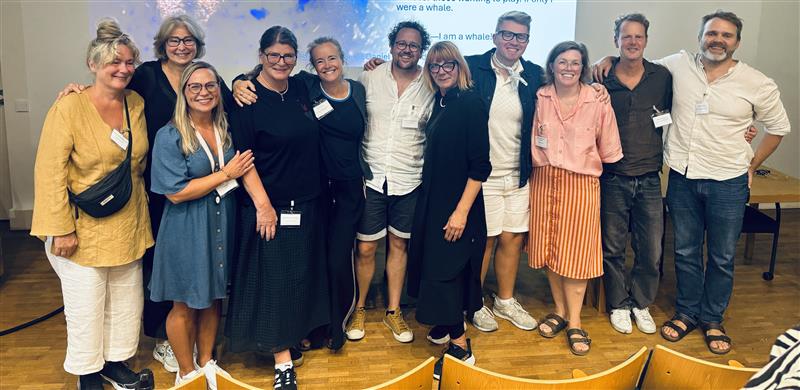
At Drama Boreale 2026 in Helsinki, members of the Nordic Performing Arts Research Network (NPARN) came together for the symposium Towards Performative Pedagogies – F(r)ictions & Potentials. The symposium brought together researchers from Finland, Sweden, Norway and Iceland to explore how performing arts and performative pedagogies can contribute to new ways of thinking about teaching, learning and education.
The symposium was an important opportunity to share current research, but also to meet, think and learn together across national and disciplinary borders.
A network emerging from SMIL
NPARN was established in connection with the SMIL – Performing Arts within Learning research and development project at the University of the Arts Helsinki. From the beginning, the network was intended to create a space for Nordic researchers, educators and artist-researchers working with performing arts and education to exchange knowledge, experiences and emerging research. The network has functioned as a support structure and an information channel, connecting researchers to the SMIL-project but also across the Nordic countries and making visible research and practices in a field that is diverse, interdisciplinary and developing rapidly.
Performing arts in educational contexts encompass many different practices, including; drama, theatre, dance, circus, music and literary arts. The research also draws on a wide range of theoretical and methodological traditions, from arts-based and performative research to posthumanist, relational and embodied approaches. This diversity is one of the field’s strengths. At the same time, it creates a need for spaces where researchers can meet, compare perspectives and develop a shared language around emerging practices.
F(r)ictions and potentials
The theme of the symposium – F(r)ictions & Potentials and the central questions currently emerging in research on performative pedagogy. What becomes possible when learning is approached through the body, imagination, artistic inquiry and relational engagement? How can performing arts reshape classroom relations and students’ experiences of agency, participation and belonging? And what happens when these approaches encounter the structures, expectations and established practices of contemporary education?
The presentations offered different perspectives on these questions. Hannah Kaihovirta and Nina Dahl-Tallgren presented research from the SMIL project, exploring how students in Finnish schools experience becoming-with performing arts and performative pedagogy. Their presentation focused on how performing arts can create transformative encounters in which students’ agency, creativity and sense of belonging are reconfigured. Elsa Szatek and Nina Dahl-Tallgren examined the epistemological frictions and potentials emerging in the SMIL material from teachers’ perspectives. Their presentation highlighted an important tension: although teachers recognise many possibilities in performative approaches, they may also experience uncertainty and hesitation when such practices challenge established understandings of teaching, knowledge and professional roles.
From Iceland, Rannveig Björk Thorkelsdóttir, Jóna Guðrún Jónsdóttir and Halldóra Rósa Björnsdóttir presented research from The Space Between, exploring theatre as a pedagogical space and performance as a site for learning. Marianne Nødtvedt Knudsen, Kristian Nødtvedt Knudsen, Remi André Slotterøy, Christer Fredriksen and Kjetil Kro Sørborg from the University of Agder presented research on transdisciplinary practices in upper-secondary arts education in Norway. Their contribution explored what emerges in the spaces between curricula, students, teachers and materials when music, dance and drama meet. Together, the presentations demonstrated the breadth of Nordic research in the field while also revealing important common questions concerning embodiment, agency, relationality, uncertainty, interdisciplinarity and transformation.
Why do we need a Nordic network?
The symposium also made something else visible: there is a growing need for continued Nordic collaboration in this field.
Research on performing arts in education often takes place across disciplinary boundaries and within relatively small research communities. Researchers may work in different institutional contexts and use different theoretical languages, while addressing remarkably similar questions. A Nordic network can help connect these perspectives. It can provide opportunities to share emerging research, identify common research questions, develop collaborative projects, support early-career researchers and create stronger connections between research, teacher education, artistic practice and educational policy.
It can also help make the field more visible. At a time when education is increasingly expected to develop creativity, collaboration, agency, critical thinking, communication and the capacity to navigate uncertainty, the knowledge developed through performing arts and performative pedagogies has much to contribute. Yet these perspectives are not always sufficiently visible in educational policy, research agendas or discussions about the future of schooling. A stronger Nordic research community can contribute to changing this.
What happens to NPARN when the SMIL project ends?
As the SMIL project approaches its conclusion, an important question is emerging: The network was created within the framework of SMIL, but the need that brought us together extends beyond a single research project. The Drama Boreale symposium demonstrated the value of having a Nordic space for exchange, and the many conversations and questions that followed the symposium further strengthened this impression. The future of NPARN therefore needs to be discussed collectively.
What should the network’s purpose be? Who should it include? How can it support research and artistic practice? What kinds of activities could create meaningful value for its members?
And how can the network contribute to strengthening the position of performing arts within education across the Nordic countries?
These are questions we will continue to explore in the coming months. For now, we are grateful for the conversations, knowledge, generosity and curiosity that shaped the symposium at Drama Boreale. NPARN is, ultimately, not only a network of researchers. It is a space for becoming-with for thinking, researching and imagining together what performing arts and education might become. And perhaps that is precisely what is needed next: not a finished structure, but a shared space in which new collaborations, questions and possibilities can emerge.
Nina Dahl-Tallgren
Chair of NPARN and Project & Research Lead of SMIL – Performing Arts in Learning, University of the Arts Helsinki. She organised and moderated the NPARN symposium at Drama Boreale 2026.
Performing arts in schools
SMIL – Scenkonst med i lärande (Performing Arts in Learning) is a development and research project that aims to explore how performing arts can be integrated as part of the national curriculum and learning environments in Finnish preschools and primary and secondary education. Welcome to follow the project on this blog!
Latest posts
-
Esittävien taiteiden tutkimuspoluilla: Dance at Play ja SMIL kohtaavat
-
Om projekt, kvalitet och vetenskaplig tillhörighet i familjen SKAPA
-
Implementering av "SMIL – scenkonst med i lärande" till skolor utanför den primära forskningsmiljön
Follow blog